Car depreciation in Ireland
What the DoneDeal listings actually show, rather than the usual rule of thumb.
Depreciation is the biggest cost of owning a car and the one nobody gets a bill for. Most of what is written about it in Ireland is a rule of thumb borrowed from the UK. The figures below are measured instead: 53,717 live DoneDeal listings and 144,152 archived observations of listings going back to 2021, grouped by model year, updated as listings arrive. Last refreshed 2026-09-16.
How fast does a car lose value in Ireland?
Across the 142 models with enough listings to fit a curve, the median works out at about 14% of the asking price a year. Half the models sit between roughly 11.6% and 16.3% a year, which is the first thing worth knowing: the spread between a model that holds on and one that does not is far wider than any single national average suggests, and it is the difference between two cars of the same price at the same age.
That rate is an average over a whole curve, not a flat yearly charge. It falls hardest at the start.
What is left after one, three and five years
Each model here is measured against its own newest well-populated model year, so the table reads as "what a car of this age still asks, as a share of a nearly-new one". The median is taken across models rather than across listings, so one very common car does not become most of the answer.
| Age | Still asks | Gone | Models | Listings |
|---|---|---|---|---|
| 1 year old | 85.2% | 14.8% | 41 | 874 |
| 2 years old | 77.6% | 22.4% | 63 | 1,691 |
| 3 years old | 71.1% | 28.9% | 98 | 2,912 |
| 4 years old | 59.4% | 40.6% | 63 | 1,497 |
| 5 years old | 58.2% | 41.8% | 67 | 1,603 |
| 6 years old | 54.2% | 45.8% | 61 | 1,175 |
| 7 years old | 47.4% | 52.6% | 70 | 1,843 |
| 8 years old | 42.5% | 57.5% | 71 | 1,807 |
The shape is the point. About 14.8% goes in the first year, and by five years old the typical model is asking 58.2% of a nearly-new one — so roughly two fifths of what a car costs to own over five years is a number nobody ever invoices.
It is worth saying where the fall stops, because the usual advice is that it settles after three or four years. On these listings it mostly does not, at least not that early: of the 142 models measured, only 19 reach an age where the year-on-year drop stops clearing 10% within the model years on record, and just 8 of those do it by year six. For the rest the fall is still running at eight years old. A model's own page prints its settling age where it has one.
Which cars hold their value best in Ireland?
These are 109 models where one model year could be priced twice — in the earliest year with ten or more listings of it, and again now — so the change is what that year of cars actually lost while it aged, not a curve fitted across different cars of different ages today. Each row names the two years it was priced in, because the earliest well-populated year differs from model to model: a change measured over two years and one measured over a single year sit in the same column here, and only the years tell them apart. "Now" is today's live listings. The full table, with the drop curve and every age band, is on the depreciation league.
Held their value best
| Model | Model year | Asked in 2024–2025 | Asked in 2025–2026 | Change |
|---|---|---|---|---|
| Peugeot Rifter | 2023 | 2024: €39,973 (10) | 2025: €39,950 (16) | −0.1% |
| Suzuki Swift | 2023 | 2025: €19,250 (15) | 2026: €18,725 (10) | −2.7% |
| Skoda Kamiq | 2023 | 2025: €22,950 (15) | 2026: €21,698 (18) | −5.5% |
| Audi Q4 e-tron | 2023 | 2025: €36,675 (20) | 2026: €33,900 (20) | −7.6% |
| Toyota Corolla Cross | 2023 | 2025: €35,995 (17) | 2026: €32,900 (69) | −8.6% |
| Ford Ranger | 2023 | 2024: €48,000 (21) | 2025: €43,817 (14) | −8.7% |
| Suzuki Vitara | 2023 | 2025: €26,473 (24) | 2026: €23,973 (10) | −9.4% |
| Audi Q2 | 2023 | 2025: €34,950 (14) | 2026: €31,475 (10) | −9.9% |
| Renault Kangoo | 2023 | 2024: €20,250 (23) | 2025: €18,250 (18) | −9.9% |
| Volkswagen Polo | 2023 | 2024: €24,950 (36) | 2026: €22,445 (13) | −10.0% |
Lost the most
| Model | Model year | Asked in 2023–2024 | Asked in 2026 | Change |
|---|---|---|---|---|
| BMW iX | 2023 | 2024: €85,473 (10) | 2026: €45,995 (17) | −46.2% |
| Citroen C5 Aircross | 2023 | 2024: €37,950 (31) | 2026: €20,450 (12) | −46.1% |
| Cupra Born | 2023 | 2023: €43,110 (26) | 2026: €23,950 (38) | −44.4% |
| Land Rover Range Rover Evoque | 2023 | 2024: €64,950 (10) | 2026: €36,200 (12) | −44.3% |
| Fiat 500 | 2023 | 2024: €19,997 (10) | 2026: €11,973 (20) | −40.1% |
| Kia EV6 | 2023 | 2024: €49,725 (18) | 2026: €29,950 (37) | −39.8% |
| Volvo XC40 | 2023 | 2024: €53,900 (19) | 2026: €32,950 (35) | −38.9% |
| Opel Corsa | 2023 | 2023: €25,950 (22) | 2026: €15,919 (24) | −38.7% |
| Peugeot 208 | 2023 | 2024: €25,845 (33) | 2026: €15,995 (17) | −38.1% |
| Skoda Enyaq | 2023 | 2024: €47,950 (15) | 2026: €29,950 (29) | −37.5% |
One honest caveat about the bottom of any such table: a model that changed generation in the period is yesterday's shape against a new one, which is part of what depreciation is but not the same thing as a car nobody wants.
Electric cars
A three-year-old electric car asks about 65.2% of a nearly-new one, against 72.2% for everything else, across 17 electric models with enough listings. They fall faster, and by a margin that is visible rather than marginal. Models are counted as electric by name rather than by the fuel field, because that field is the seller's own tick-box and several names are sold in both drivetrains — grouping on it would mix a petrol car's curve into the electric answer.
Common questions
How much does a car lose in value per year in Ireland?
Across the 142 models tracked here, the median is about 14% of the asking price a year, fitted across each model's own model years. That is an average over a whole curve and not a flat rate: the first years fall much harder than the later ones.
How much does a new car lose in the first year in Ireland?
A one-year-old car still asks about 85.2% of what a nearly-new one asks, so roughly 14.8% has gone in the first year. By three years old that is down to about 71.1%, measured across 98 models.
At what age does a car stop depreciating in Ireland?
Later than the usual advice suggests. Of the 142 models measured here, only 19 reach an age where the year-on-year drop stops clearing 10% within the model years on record, and only 8 of those manage it by year six; for the rest the fall is still running at eight years old. The steepest part is over early, but "stops depreciating" is a different claim and the listings mostly do not support it.
Do electric cars depreciate faster in Ireland?
On these listings, yes. A three-year-old electric car asks about 65.2% of a nearly-new one, against 72.2% for everything else, across 17 electric models. Electric models are grouped by name rather than by the fuel field, because the fuel field is the seller's own tick-box and several names are sold in both drivetrains.
Are these sale prices or asking prices?
Asking prices, always. They are what sellers wanted for 53,717 live DoneDeal listings and 144,152 archived observations of them, which is the number a buyer negotiates down from rather than what any one car fetched. Nothing about a seller is stored.
Look up your own car
Every figure above is an average over many models, and the model you are actually looking at may be nowhere near it. The depreciation tracker gives the curve for one make and model, filtered down to trim, engine size, fuel, gearbox and body, and there is a page for every model the listings support one for.
Now check the one you are actually looking at
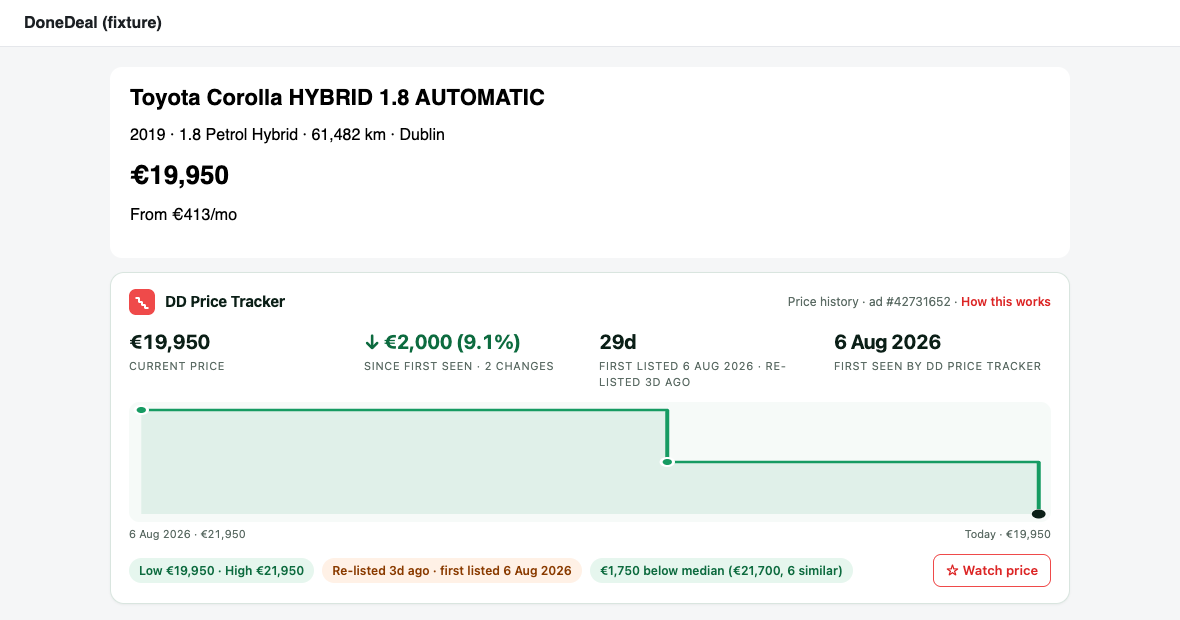
You now know what these cars cost. DD Price Tracker puts the price history, the date the ad really first appeared and the median of similar cars under the price on every DoneDeal ad you open. You will know what the seller knows before you ring.
Free, no account, and nothing about you is stored. On an Android phone it runs in Firefox: the Android guide.
What these numbers are, and what they are not
They are asking prices, never sale prices: what sellers wanted, which is the number a buyer negotiates down from. They describe the market as it stands today rather than predicting what any one car will be worth next year, and a car's own condition, mileage and service history move it well off any median. Listings that have since sold or been removed are counted, because a sold car's last asking price is still a market observation. Sterling listings from the North are left out, because a price without VRT in it is not comparable.
Where a model year could be priced in an earlier year as well as now, that comes from archived copies of public DoneDeal listing pages held by the Internet Archive — a sample that is strong for 2021, 2024 and 2025 and thin for 2022 and 2023. Nothing personal is stored from any listing: no seller names, no phone numbers, no photos, no descriptions.
What the Irish used-car market did last month
One short email a month: which models moved, where the falls are steepest, and what a year of age is costing. Nothing else, no forwarding, and one click unsubscribes and deletes your address. How we handle it.