How to import a car from Japan to Ireland
The price on the exporter's page is the start of the bill, not the end of it.
Japan sells right-hand-drive cars with low mileage, full service records and grades from an auction inspector, and Irish buyers have been bringing them in for decades. What has changed is the tax: since 1 February 2026 the EU customs duty on a Japanese car is 0% when the paperwork is right and 10% when it is not, and every Japanese import pays 23% VAT and then VRT on Revenue's own Irish valuation. This page is the order to do it in, what each stage adds, and which Revenue page each rule comes from with the day we read it. It is written for a private buyer bringing in one car. No shipping price is quoted, because the components are described below and the figure is yours to get from a forwarder.
- Find the car and read the grade.Goo-net Exchange, BE FORWARD, SBT Japan, TCV or Car From Japan, or an agent bidding at auction for you. The auction sheet is the inspection you cannot do yourself.
- Understand the price.FOB is the car on the ship in Japan. Freight, insurance, port charges, agent, duty, VAT and VRT all come after it.
- Agree the statement on origin before you pay.It is what turns the 10% duty into 0%, and it cannot be added once the car has sailed.
- Ship it: RoRo or container.From a Japanese port to Dublin, often through a European hub. Weeks at sea. Insure it.
- Clear customs in Ireland.The declaration, the duty at 0% or 10%, and 23% VAT on price plus freight plus insurance plus duty.
- Book the NCTS within 7 days of arrival and register within 30.Revenue sets the OMSP, charges VRT and NOx, and issues the Irish registration.
The yen price and the Irish one, side by side
Step 2 above is the one that catches people out: a FOB price in yen tells you nothing about what the car is worth at the end of the journey. DD Price Tracker puts both numbers on the exporter’s own page.
- The euro price for the yen or dollar figure, at Revenue’s own monthly customs rate — the rate the duty and VAT will be worked on.
- The Irish median for the same make, model and year already here, registered and with VRT paid, so the gap you are shipping into is on screen before you commit.
- Duty, VAT, VRT and the landed cost in one tap, with the make, model, year and price carried across from the listing.
Free, no account, nothing about you stored. Chrome, Edge, Firefox and Safari. On Android it runs in Firefox.



Where people buy
Five exporter sites carry most of the stock Irish buyers browse, and all five are ones the DD Price Tracker extension reads. They are not marketplaces of private sellers the way DoneDeal is. Each is an exporter or a network of exporters selling stock it holds or can buy at auction, with the export paperwork, inland transport and loading as part of the service.
- Goo-net Exchange (goo-net-exchange.com): the export arm of Japan's largest domestic listings site; prices in yen.
- BE FORWARD (beforward.jp): a large exporter with its own stock; prices in US dollars. Not all of its stock is in Japan. Some cars sit in Thailand or Korea, and a car shipped from there is not a Japanese export for customs purposes: the EU-Japan 0% rate does not apply to it. The listing names the location; read it.
- SBT Japan (sbtjapan.com): exporter with its own stock; prices in US dollars.
- TCV (tc-v.com, formerly tradecarview): a marketplace of many Japanese exporters; prices in US dollars.
- Car From Japan (carfromjapan.com): a marketplace of exporters; prices in US dollars.
The other route is an auction agent: a company in Japan, or an Irish importer with one, that bids for you at the big auction houses (USS is the largest) off the auction sheet and charges a fee on top of the hammer price. You see more cars and pay less for each, and you take on the export process yourself or through the agent.
What the listed price does and does not include
Exporters quote in one of three ways, and the letters matter more than the number:
- FOB (free on board): the car delivered onto the ship at the Japanese port, with the exporter's fee, the export certificate and inland transport in Japan. This is what most of the five sites show by default.
- C&F (cost and freight): FOB plus the ocean freight to your port.
- CIF (cost, insurance and freight): C&F plus marine insurance. This is the figure Irish customs duty is worked on, so it is the one to think in.
None of the three includes what happens in Ireland: port and terminal handling charges at Dublin, the customs agent's fee for lodging the declaration, customs duty, import VAT, VRT, the NOx levy, plates, motor tax, insurance or the NCT. The euro figure an exporter prints beside a dollar or yen price is its own rate on the day; Revenue works duty and VAT on its own monthly customs exchange rate, which is what the extension and the VRT calculator use.
Check the car: the auction sheet and an inspection
You will not see the car before you buy it, so the paperwork does the looking. Most Japanese used cars pass through an auction, and the auction house inspects each one and grades it on a sheet that the exporter can give you.
- The overall grade runs from S or 6 (as new) through 5, 4.5, 4 and 3.5 (good used cars with wear that increases as the number falls) to 3 and below (noticeable damage or poor condition). A grade of R or RA means the car has had accident repairs; the sheet says where.
- The interior grade is a letter, A to D, and is separate from the overall grade.
- The diagram marks every panel with a code for scratches, dents, rust and replaced panels, with a number for severity. A car graded 4 with a clean diagram is a different car from a 4 with three panels marked.
- The mileage on the sheet is what the inspector read, in kilometres. Odometer tampering exists, and an independent pre-shipment inspection and odometer check, which the exporter can arrange for a fee, is the answer where the sheet is missing or the price makes it worth it.
Ask for the auction sheet, the chassis number and clear photographs of the underside, and ask when the car was last on the road in Japan. A car that has been sitting in a yard for a year is a car that will need tyres and a battery.
Shipping
Two ways to move a car by sea, and the exporter or a freight forwarder books either:
- RoRo (roll on, roll off): the car is driven onto a vessel built for cars and driven off at the other end. Typically the cheaper of the two for one car, with no packing, but the car travels in the open hold and you cannot ship anything inside it.
- Container: the car is secured inside a 20-foot or shared 40-foot container. Typically dearer for a single car, but it is enclosed, and a shared container is how an importer moves several cars at once.
Cars typically leave from Yokohama, Nagoya, Osaka or Kobe. Direct RoRo services to Dublin are not frequent, so a Japanese car often comes through a European hub such as Southampton, Zeebrugge or Rotterdam and onward to Dublin by a second vessel, or lands in Britain and crosses the Irish Sea from there. Either way the sea leg is measured in weeks, not days, and the forwarder's quote will say how many. Marine insurance for the voyage is a separate line and worth having, because a car that arrives damaged is your problem after it is unloaded.
When the car lands you will be charged port and terminal handling, and the shipping line will not release the car until the customs declaration is made and the duty and VAT are paid. A customs agent does the declaration for a fee; the bill of lading is the document that ties the car to the shipment and is also your evidence of the date it entered the State.
Customs: the declaration and the 0% or 10%
A car from Japan is an import from outside the EU, so a customs declaration must be made when it arrives, and Revenue's NCTS asks for the declaration's Master Reference Number (MRN) before it will register the car. The customs value is the price paid plus the cost of transport and insurance to the EU: the CIF figure.
Revenue, VAT and Customs Duty, published 9 July 2026; Revenue, procedure at the NCTS centre, published 24 August 2026. Read 18 September 2026.The standard duty on a passenger car (tariff heading 8703) is 10% of the customs value. Under the EU-Japan Economic Partnership Agreement the tariff preference for Japan on that heading has been 0% since 1 February 2026, and the calculator cites both rates from the EU's TARIC database. The preference is not automatic. It is claimed with a statement on origin: a set form of words the Japanese exporter puts on the invoice or another commercial document, carrying its Japan Corporate Number, declaring that the car meets the Agreement's rules of origin. Agree it when you agree the sale, because the shipping paperwork does not carry it by default and it cannot be added once the car has left. A Japanese registration or export certificate proves where the car was registered, not where it originates under the Agreement, so it is not a substitute. A car shipped from an exporter's yard in Thailand or Korea is not a Japanese export and gets no preference.
EU TARIC, heading 8703: erga omnes 10%; Japan tariff preference 0% from 1 February 2026 (D1907/18). Read 16 September 2026.Some Irish guides still describe Japanese duty as "usually 2.5% or 10%". The 2.5% was the Agreement's staged rate as it stood in 2024, and it has expired; a page that quotes it without a date is a page that has not been re-read.
Import VAT at 23%
Private imports are subject to VAT at import at the standard rate, currently 23%, on the customs value plus any customs duty payable: the price, plus transport and insurance, plus the duty. It is paid with the customs declaration, and the NCTS requires proof of payment of the customs duty and VAT before it registers the car. Revenue's page on this is written for Great Britain and Northern Ireland, but the VAT-at-import rule it states is the general one for a car from outside the EU.
Revenue, VAT implications of importing vehicles from Great Britain and Northern Ireland, published 24 August 2026; Revenue, VAT and Customs Duty, published 9 July 2026. Read 18 September 2026.VRT and the NOx levy
VRT is a percentage of the Open Market Selling Price, set by the car's CO2 figure. For a Category A car (an M1 passenger car) there are 20 bands, from 7% of the OMSP or €140, whichever is greater, at 0 to 50 g/km, to 41% or €820 at more than 190 g/km.
Revenue, applying the tax, published 21 July 2026, read 18 September 2026.The OMSP is Revenue's Irish valuation, not the Japanese price. It is Revenue's own view of what the car would sell for in Ireland, usually different from the invoice, and for a car not in Revenue's calculator it is determined only after the car is presented for registration, using UK and Irish trade guides, advertisements and experts. A bargain at auction in Nagoya does not lower it. Before the NCTS the closest public figure is the Irish asking-price median for that make, model and year, which is what the VRT calculator uses when you have no OMSP yet, and it says so on every result. For a model that was never sold new in Ireland there may be no median at all, and the calculator says that too rather than guessing.
Revenue, assessing the value, published 9 July 2026, read 18 September 2026.The NOx levy is charged on top, on all Category A vehicles excluding electrics but including hybrids: €5 per mg/km on the first 40, €15 on the next 40 up to 80, and €25 on the remainder. Where NOx cannot be evidenced Revenue charges a flat maximum of €4,850 for a diesel and €600 for anything else. This matters more for a Japanese car than a UK one: the NCTS asks for confirmation of the CO2 and NOx at the time of manufacture, the Japanese export certificate does not carry them in the form Revenue wants, and a model built for the Japanese market only has no row in the UK or European type-approval data the calculator looks up. Ask the exporter what emissions documentation it can supply for the exact variant before you buy, and if the answer is none, budget for the maximum.
Revenue, calculating the NOx charge, published 9 July 2026; Revenue, procedure at the NCTS centre, published 24 August 2026. Read 18 September 2026.A battery electric car registered before 31 December 2026 gets VRT relief of up to €5,000 where the OMSP is up to €40,000, a reduced relief between €40,000 and €50,000, and none above that.
Revenue, electric vehicles, published 9 July 2026, read 18 September 2026.Registering: 7 days, 30 days and what to bring
You must make an appointment with the NCTS within seven days of bringing the vehicle into the State and register it within 30 days. Fail the 30 days and you pay additional VRT, which Revenue says usually arises where evidence of the date of entry is not produced. Bring:
- the foreign registration certificate or certificate of de-registration issued by the registration authority in Japan: the export certificate (the deregistration document Japan issues when a car is taken off its register for export). Keep the original; ask the NCTS in advance whether it wants a translation;
- confirmation of the CO2 and NOx emission levels at the time of manufacture;
- an invoice clearly showing the date of purchase, in your name;
- the vehicle purchase details form (VRTVPD1 or VRTVPD2);
- a passport or driving licence, and a hard-copy utility bill or bank statement for the registered owner's name and address;
- the PPSN of the person who will be the registered owner;
- evidence of the date the vehicle entered the State: the shipping documents, which for a Japanese car means the bill of lading and the arrival notice;
- the customs declaration MRN, and proof the duty and VAT were paid.
The car is examined at the centre to make sure it matches the documents, and if the documents are not supplied or the car does not match them it is not registered.
Revenue, VRT and registration, published 10 July 2026; Revenue, procedure at the NCTS centre, published 24 August 2026. Read 18 September 2026.After registration
Plates, motor tax through the ordinary Irish system, insurance on the new registration, and the NCT on the same schedule as any Irish car: a Japanese shaken certificate is not an NCT. Two small practical points that catch people: a Japanese-market radio tunes the Japanese FM band, so Irish stations above about 90 MHz are out of its range until the head unit is changed or a band expander is fitted, and the built-in navigation and its menus are in Japanese. Insurers vary in how they treat a model that was never sold here, so ring yours with the exact model before you buy rather than after.
Where the money goes
No figures, because each one is either yours (the price, the freight, the agent) or Revenue's (the OMSP). What is fixed is who sets each component and what it is worked on.
| Component | Worked on | Set by |
|---|---|---|
| Price (FOB) | The exporter's yen or dollar price, converted at Revenue's monthly customs rate | You and the exporter |
| Ocean freight | RoRo or container, port to port | The shipping line or forwarder |
| Marine insurance | The voyage | The insurer |
| Port and handling charges | At arrival | The port and the line |
| Customs declaration | Required; agent's fee | Revenue; the agent sets the fee |
| Customs duty | 10% of price + freight + insurance, or 0% with a statement on origin | EU TARIC |
| Import VAT | 23% of price + freight + insurance + duty | Revenue |
| VRT | 7% to 41% of the OMSP by CO2 band | Revenue, on its own Irish OMSP |
| NOx levy | By mg/km; €4,850 or €600 maximum unevidenced | Revenue |
| Plates, motor tax, insurance, NCT | As for any Irish car | Various |
Revenue publishes the exchange rates to be used in determining customs value once a month, for yen and dollars as well as sterling. That is the rate the duty and VAT are legally worked on; your bank's rate on the day you pay the exporter will differ.
How DD Price Tracker helps
The free extension reads Goo-net Exchange, BE FORWARD, SBT Japan, TCV and Car From Japan. There is nothing to set up and no account to make:
- Install it onceOne click from your browser’s store. It asks for the car sites it reads and nothing else.
- Open any listingThe panel draws itself under the exporter’s price the moment the page loads.
- Read the three numbersEuro price, Irish median, and the button through to the duty, VAT, VRT and landed cost.
What that panel puts under the price:
- The euro price for the yen or dollar figure at Revenue's own monthly customs exchange rate, the month named, so it is the rate the duty and VAT will actually be worked on.
- The Irish median asking price for the same make, model and year on Irish plates with VRT paid, from the DoneDeal listings behind the depreciation tracker, where there are enough listings to say, and a sentence that an FOB price cannot be compared with it until the landed cost is worked out.
- The import note: FOB before shipping, duty at 10% or 0% with a statement on origin, 23% VAT on price plus freight plus insurance, then VRT and NOx on Revenue's own OMSP, and, where the exporter holds the car outside Japan, that the 0% does not apply.
- A link that opens the VRT calculator on the Japan route with the currency, price, make, model, year, fuel, mileage and month of registration filled in. It never presses the button for you.
These sites are read and never tracked. An exporter's price is stock in a yard in Japan for a car that has paid no duty, VAT or VRT; it is not an Irish asking price, so no price history is kept on them and nothing from them reaches the depreciation pages or the league. Nothing about the listing is stored or sent. Weighing the UK instead? The UK import guide covers the Northern Ireland proofs, the Great Britain declaration and the sites the extension tracks there.
Common questions
Is there customs duty on a car from Japan?
The standard rate on a passenger car from outside the EU is 10% of the customs value (price plus freight plus insurance). Under the EU-Japan Economic Partnership Agreement the preferential rate on heading 8703 has been 0% since 1 February 2026, but only if the Japanese exporter gives you a statement on origin in the Agreement's wording, carrying its Japan Corporate Number. A Japanese registration or export certificate is not a statement on origin. Some Irish guides still quote 2.5%, which was the staged rate in 2024.
What does an FOB price include?
Free On Board: the car delivered onto the ship at the Japanese port, with the exporter's fee and the export paperwork, and nothing after that. It excludes ocean freight, marine insurance, Irish port and handling charges, the customs agent, customs duty, 23% import VAT, VRT, the NOx levy, plates, motor tax, insurance and the NCT. Some exporters also quote C&F (price plus freight) or CIF (price plus freight plus insurance), which is the figure Irish customs duty is worked on.
How is import VAT worked out on a Japanese car?
At the standard rate, currently 23%, on the customs value plus any customs duty payable: the price paid, plus the cost of transport and insurance, plus the duty. It is paid with the customs declaration, and the NCTS requires proof of payment of customs duty and VAT before it registers the car (Revenue, VAT implications of importing vehicles, published 24 August 2026).
Does Revenue care what I paid in Japan when it sets VRT?
No. VRT is a percentage of the Open Market Selling Price, which is Revenue's own valuation of what the car would sell for in Ireland. For a car not in its calculator, Revenue sets the OMSP only after the car is presented at the NCTS, using UK and Irish trade guides, advertisements and experts (Revenue, assessing the value, published 9 July 2026). A low auction price in Japan does not lower the VRT.
What does the extension show on Goo-net Exchange, BE FORWARD, SBT Japan, TCV and Car From Japan?
One panel under the exporter's price: the euro figure at Revenue's monthly customs exchange rate for yen or dollars, the median asking price for the same make, model and year on Irish plates with VRT paid, a note that an FOB price cannot be compared with that until the landed cost is worked out, and a link that opens the VRT calculator on the Japan route with the currency, price, make, model, year, fuel, mileage and registration month filled in. Nothing about the listing is stored or sent, and no price history is kept on these sites.
Before you go
Now check the one you are actually looking at
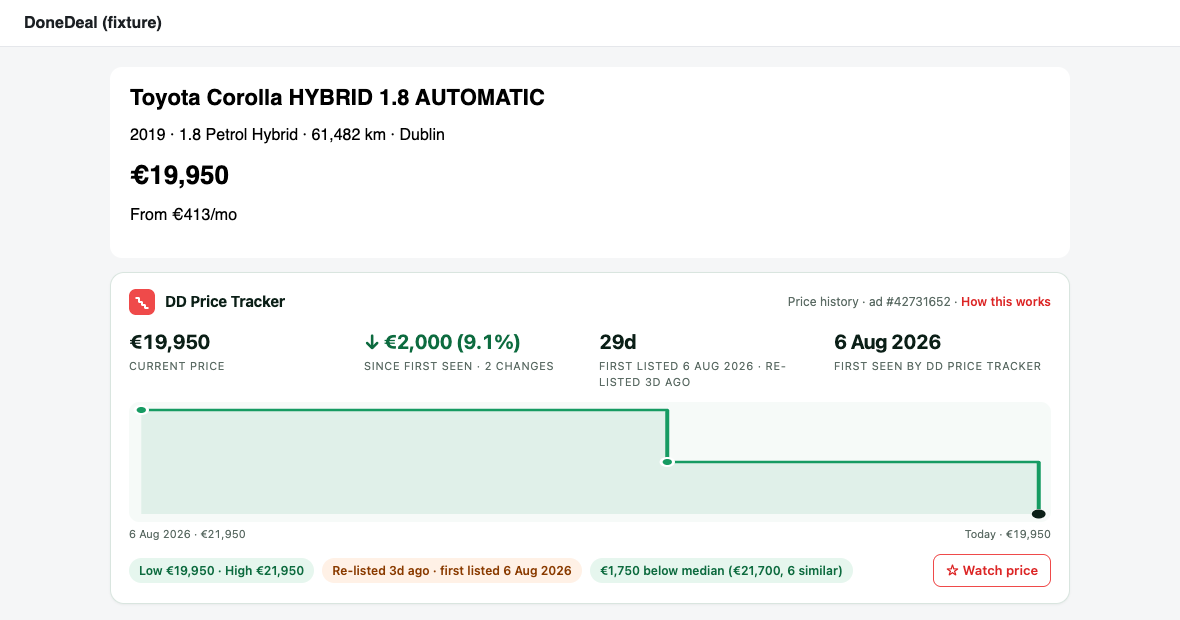
You now know what these cars cost. DD Price Tracker puts the price history, the date the ad really first appeared and the median of similar cars under the price on every DoneDeal ad you open. You will know what the seller knows before you ring.
Free, no account, and nothing about you is stored. On an Android phone it runs in Firefox: the Android guide.
Sources, and what this page is not
This is a guide, not tax advice, and Revenue decides the final amount at the NCTS. Every rule above is taken from the page named beside it, read on the date given. Shipping durations and every cost that is not a tax rate are described and not quoted, because they are set by the forwarder, the line and the port on the day, and a figure typed here would be wrong by the time you read it. The auction grading scale is described as the auction houses generally use it; each house prints its own key on the sheet. Irish asking prices on this site are what sellers ask, never what cars sell for, because what cars actually sell for in Ireland is not public.
- Revenue, VRT and registration, published 10 July 2026: the seven-day appointment and the 30-day registration.
- Revenue, VAT and Customs Duty, published 9 July 2026: duty at importation from outside the EU; proof of payment at the NCTS.
- Revenue, VAT implications of importing vehicles, published 24 August 2026: 23% on price plus transport, insurance and duty.
- Revenue, Applying the tax, published 21 July 2026: the CO2 bands.
- Revenue, Calculating the NOx charge, published 9 July 2026: the levy and its maxima.
- Revenue, Assessing the value, published 9 July 2026: the OMSP.
- Revenue, Electric vehicles, published 9 July 2026: the battery electric relief.
- Revenue, Procedure at the NCTS centre, published 24 August 2026: the documents, including the certificate of de-registration and the customs MRN.
- Revenue, Exchange rates to be used in determining customs value: the monthly table the euro figures use.
- EU TARIC, heading 8703, read 16 September 2026: 10% erga omnes; 0% Japan preference from 1 February 2026 (D1907/18).
What the Irish used-car market did last month
One short email a month: which models moved, where the falls are steepest, and what a year of age is costing. Nothing else, no forwarding, and one click unsubscribes and deletes your address. How we handle it.