How to import a car from the UK to Ireland
Great Britain and Northern Ireland are two different bills. Everything else is paperwork and dates.
Used imports are the fastest-growing part of the Irish market: 63,815 in the first eight months of 2026, up 37% on the same period last year (SIMI, August 2026 release). Every one of those cars paid VRT, and most of them crossed the Irish Sea or the border first. This page is the order to do it in, what each step costs in principle, and which Revenue page each rule comes from, with the day we read it. It is written for a private buyer bringing in one car. It does not quote a shipping or ferry price, because those change weekly and are yours to get.
- Decide North or Britain first.A car that was legally in Northern Ireland is VRT only. A Great Britain car pays customs duty and 23% VAT before VRT. That one fact changes the price you can afford to pay.
- Find the car and check it.Auto Trader UK for Britain, Used Cars NI for the North. MOT history, keeper history, finance and write-off checks before you travel.
- Get the documents while you still have the seller's attention.The whole V5C, the invoice, and for a GB car the statement on origin; for an NI car the NI import declaration.
- Bring it home and declare it.A Great Britain car needs a customs declaration, duty where applicable and import VAT. A Northern Ireland car with proof needs none of that.
- Book the NCTS within 7 days and register within 30.Revenue sets the OMSP, charges VRT and the NOx levy, and issues the Irish registration.
- Plates, motor tax, insurance, NCT.The ordinary Irish running of a car starts here.
Every UK ad, already priced in euro
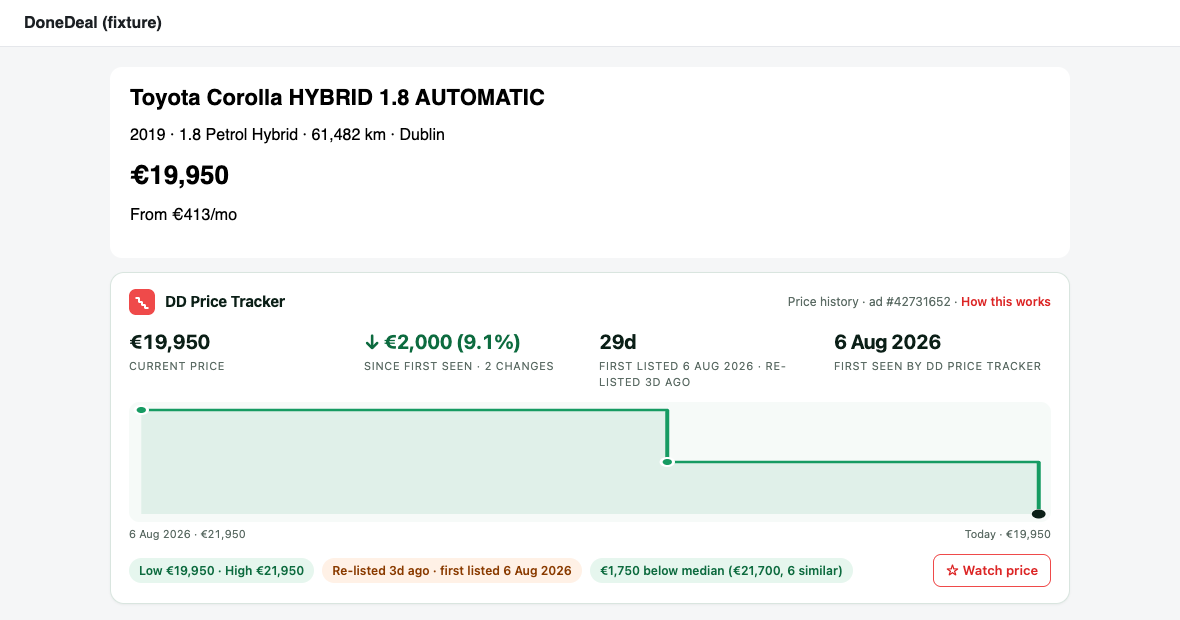
Steps 2 and 5 above are the two that cost money, and both of them start with a number the ad does not show you. DD Price Tracker prints that number on the ad while you are still looking at it.
- The euro price under the sterling one, at Revenue’s own monthly customs rate — the rate the duty and VAT will actually be worked on, not a bank’s rate of the day.
- The Irish median for the same make, model and year already on Irish plates with VRT paid, so you can see in a second whether the import is worth the ferry.
- The VRT estimate in one tap, with the route, the price, the make, model and year already filled in from the ad.
Free, no account, nothing about you stored. Chrome, Edge, Firefox and Safari. On Android it runs in Firefox.



Where people buy
Two sites carry most of the stock Irish buyers look at, and both are ones the DD Price Tracker extension reads.
Auto Trader UK (autotrader.co.uk)
The market Great Britain imports actually come from. Prices are in sterling. The ad page names the make, model and year, the mileage in miles, whether the seller is a dealer or private, and a town. It does not print a listing date, so a price history on Auto Trader starts the first time someone with the extension opens the ad. Most of the stock is dealer stock, and a dealer selling to an Irish buyer is the person who has to give you the statement on origin, so ask before you agree a price.
Used Cars NI (usedcarsni.com)
Where the North's dealers and private sellers list. The site knows who is reading: every ad carries an approximate euro price, a VRT estimate link and finance and insurance links for the Republic. Ad pages print the price the car was first listed at, the current price and the days it has been on the site, which is why the extension can show a cut on an ad the first time it is opened. About 96% of the stock is trade. The important thing about Used Cars NI is that a car listed there is not automatically a Northern Ireland car for Revenue's purposes: dealers in the North sell Great Britain stock, and it is the car's own history, not the dealer's address, that decides the bill.
What the listed price does and does not include
The sterling price is the seller's asking price for the car where it stands, and nothing more. It does not include the ferry, the fuel to get there and back, the customs declaration (an agent will charge for lodging it), customs duty, import VAT, VRT, the NOx levy, Irish plates, motor tax, insurance or the NCT. On a Great Britain car the tax alone can be a large fraction of the price. The euro figure a site prints beside a sterling price is that site's own rate on the day; Revenue works duty and VAT on its own monthly customs exchange rate, which is the rate the extension and the VRT calculator use.
Northern Ireland or Great Britain: the question that decides the bill
Since 1 January 2021 Revenue treats a vehicle from Great Britain as an import from outside the EU, so customs duty and import VAT apply before VRT is even considered. A vehicle from Northern Ireland attracts neither, provided it was legally in Northern Ireland.
Revenue, VAT and Customs Duty, published 9 July 2026; Revenue, registration of imported used vehicles, published 24 August 2026. Both read 18 September 2026.What Revenue accepts as proof that the car was legally in the North, in its own order:
- An NI import declaration showing the vehicle was imported into Northern Ireland under the Windsor Framework. Whoever brought the car from Great Britain into the North, usually the dealer, made this declaration at the time. Ask for a copy before you pay.
- Or, at Revenue's discretion, other proof that the car was in use in NI before you bought it. Revenue asks as a minimum for the original V5C issued at the time of purchase showing the last registered keeper resident in Northern Ireland, a vehicle service history in NI, and an MOT test history in NI.
- A vehicle that was already in Northern Ireland before 1 January 2021 and has stayed there also qualifies.
Without one of those, Revenue says customs duty and import VAT may arise in addition to VRT: the car is charged as a Great Britain import. A dealer's address in the North on the V5C is not a keeper resident in NI. Northern Ireland MOT results on the GOV.UK history checker go back only to 2017, so ask the seller for the DVA test certificates themselves.
Check the car before you travel
- MOT history. GOV.UK's free check, by registration number, gives every test result since 2005, the mileage recorded at each test and the next due date. The mileage trail is the single best fraud check you have: it should climb steadily, and a jump downwards is a car to walk away from.
- The V5C. Ask the seller to photograph the front of it. The registered keeper's name and address, the date of first registration, the number of former keepers and the CO2 figure are all there. The CO2 figure is what your VRT band is set on, so note the basis (NEDC or WLTP) it carries.
- Outstanding finance, write-off and theft. A paid history check (HPI and its competitors) covers finance owed, insurance write-off categories, mileage anomalies and a stolen marker. A car with finance on it belongs to the finance company until it is cleared, whatever the seller says.
- Keeper and location. For a car you hope to treat as a Northern Ireland import, the checks above should all say Northern Ireland: keeper's address, MOT centres, service stamps. If they say Birmingham, plan for the Great Britain bill.
- The price against Ireland. A UK car is only cheap after duty, VAT, VRT and the journey are added. The extension puts the Irish median asking price for the same make, model and year beside the ad, and the depreciation tracker shows what the same car asks at every age here, so the comparison is made before you buy the ferry ticket.
Paying, and getting the paperwork right at the point of sale
- The whole V5C. The seller fills in the permanent export section of the V5C and sends that slip to DVLA; you keep the rest of the document, and you will not register the car in Ireland without it. Revenue says the same thing in its own words: it is essential to get the rest of the V5C from the seller.
- An invoice showing the date of purchase, in your name, with the price and the vehicle identification number. The NCTS asks for it, and the customs value is worked from it.
- A statement on origin (Great Britain only). A set form of words the UK exporter puts on the invoice or another commercial document, with the exporter's reference number, declaring that the car meets the EU-UK Trade and Cooperation Agreement's rules of origin. With it the customs duty is 0%. Without it, 10%. It cannot be added after the car has left, so it is agreed at the sale or not at all. A UK registration, a UK badge or a car assembled in Britain is not proof of origin on its own.
- The NI import declaration (Northern Ireland only), or the V5C, service and MOT history described above.
- Proof of the date the car entered the State. Keep the ferry booking and boarding pass. The NCTS asks for shipping or travel documents, and the 7 and 30 day clocks run from that date; where the date cannot be shown, Revenue says additional VRT usually follows.
Bringing it home
Most private buyers drive the car onto a ferry: Holyhead, Liverpool or Fishguard to Dublin or Rosslare for a Great Britain car, or simply across the border for a Northern Ireland one. A transporter is the alternative when you do not want to travel or the car is not insured for the journey. Ring your insurer before you go, because cover on a car still on UK plates for the drive home, and until the Irish plates are issued, varies between insurers and is not something to discover at the port.
Customs: the declaration and the duty
A Great Britain car must have a customs declaration made in Ireland before it is registered. Revenue's page puts it in three lines: complete a customs declaration, pay customs duty where applicable, pay VAT on the import value. The declaration is lodged electronically, usually by a customs agent for a fee, and it produces a Master Reference Number (MRN) that the NCTS asks to see. A vehicle not declared and registered within 30 days of arrival is liable to seizure.
Revenue, registering a vehicle purchased in Great Britain, published 24 August 2026, read 18 September 2026.The duty rate on a passenger car, tariff heading 8703, is 10% of the customs value, which is the price paid plus transport and insurance to the EU border. With a statement on origin under the Trade and Cooperation Agreement the preferential rate is 0%. The 10% and the 0% both come from the EU's TARIC database, which is where the calculator cites them from.
EU TARIC, heading 8703: erga omnes 10%; United Kingdom tariff preference 0% (D2253/20). Read 16 September 2026.A Northern Ireland car with proof needs no declaration, no duty and no import VAT.
Import VAT at 23%
Private imports from Great Britain are subject to VAT at import at the standard rate, currently 23%. Revenue charges it on the purchase price plus the cost of transport and insurance plus any customs duty payable, so on a car that paid the 10% duty, the VAT is worked on the price and the duty together. It is paid with the customs declaration, and the NCTS requires proof of payment of the customs duty and VAT before it registers the car.
Revenue, VAT implications of importing vehicles from Great Britain and Northern Ireland, published 24 August 2026; Revenue, VAT and Customs Duty, published 9 July 2026. Read 18 September 2026.VRT and the NOx levy
VRT is a percentage of the Open Market Selling Price, and the percentage is set by the car's CO2 figure. For a Category A car (an M1 passenger car) there are 20 bands, from 7% of the OMSP or €140, whichever is greater, at 0 to 50 g/km, up to 41% or €820 at more than 190 g/km. The CO2 basis matters: an older car's V5C carries an NEDC figure, and Revenue converts it before banding, so feeding an NEDC figure in as WLTP puts the car in the wrong band.
Revenue, applying the tax, published 21 July 2026, read 18 September 2026.The NOx levy is charged on top, on all Category A vehicles excluding electrics but including hybrids: €5 per mg/km on the first 40, €15 on the next 40 up to 80, and €25 on the remainder. Where NOx cannot be evidenced Revenue charges a flat maximum of €4,850 for a diesel and €600 for anything else. NOx is often missing from a V5C, and the gap between the maximum and the real figure on a typical modern diesel is the single largest avoidable cost on this page, which is why the calculator looks the figure up in the UK Vehicle Certification Agency's published data for you.
Revenue, calculating the NOx charge, published 9 July 2026, read 18 September 2026.The OMSP is Revenue's number, not yours. It is Revenue's own valuation of what the car would sell for in Ireland, and it is usually different from the invoice. For a car that is not in Revenue's own calculator, Revenue determines the OMSP only after the car is presented for registration, using UK and Irish trade guides, advertisements and experts. What you paid in Sheffield does not enter into it. Before the NCTS the closest public figure is the Irish asking-price median for that make, model and year, which is what the VRT calculator uses when you have no OMSP yet, and it says so on every result.
Revenue, assessing the value, published 9 July 2026, read 18 September 2026.A battery electric car registered before 31 December 2026 gets VRT relief of up to €5,000 where the OMSP is up to €40,000, a reduced relief between €40,000 and €50,000, and none above that.
Revenue, electric vehicles, published 9 July 2026, read 18 September 2026.Registering: 7 days, 30 days and what to bring
You must make an appointment with the NCTS within seven days of bringing the vehicle into the State and register it within 30 days. Fail the 30 days and you pay additional VRT, which Revenue says usually arises where evidence of the date of entry is not produced. Bring:
- the foreign registration certificate: the V5C, whole;
- confirmation of the CO2 and NOx emission levels at the time of manufacture (the V5C or the Certificate of Conformity);
- an invoice clearly showing the date of purchase;
- the vehicle purchase details form (VRTVPD1 or VRTVPD2);
- a passport or driving licence, and a hard-copy utility bill or bank statement for the registered owner's name and address;
- the PPSN of the person who will be the registered owner;
- evidence of the date the vehicle entered the State: shipping details or travel documents;
- for a Great Britain car, the customs declaration MRN and proof the duty and VAT were paid; for a Northern Ireland car, the NI import declaration or the V5C, service and MOT proofs above.
The car is examined at the centre to make sure it matches the documents. If the documents are not supplied, or the vehicle does not match them, it is not registered.
Revenue, VRT and registration, published 10 July 2026; Revenue, procedure at the NCTS centre, published 24 August 2026. Read 18 September 2026.After registration
You get an Irish registration number and have the plates made. Motor tax is then due through the ordinary Irish system, insurance moves to the new registration, and the car falls under the NCT on the same schedule as any Irish car: a UK MOT is not an NCT and does not carry over. Book the test through the NCTS if one is due.
Where the money goes
No figures, because every one of them is either yours (the price, the ferry, the agent) or Revenue's (the OMSP). What is fixed is who sets each component and what it is worked on.
| Component | Great Britain | Northern Ireland, with proof | Set by |
|---|---|---|---|
| Price | The seller's sterling price | The seller's sterling price | You and the seller |
| Transport | Ferry or transporter | The drive | You |
| Customs declaration | Required; agent's fee | Not required | Revenue; the agent sets the fee |
| Customs duty | 10% of price + transport + insurance, or 0% with a statement on origin | None | EU TARIC |
| Import VAT | 23% of price + transport + insurance + duty | None | Revenue |
| VRT | 7% to 41% of the OMSP by CO2 band | 7% to 41% of the OMSP by CO2 band | Revenue, on its own OMSP |
| NOx levy | By mg/km; €4,850 or €600 maximum unevidenced | The same | Revenue |
| Plates, motor tax, insurance, NCT | As for any Irish car | As for any Irish car | Various |
The euro conversion of the sterling price is made at Revenue's monthly customs exchange rate for duty and VAT. Your bank's rate on the day you pay will be different.
How DD Price Tracker helps
The free extension reads Auto Trader UK and Used Cars NI as well as DoneDeal. There is nothing to set up and no account to make:
- Install it onceOne click from your browser’s store. It asks for the three car sites and nothing else.
- Open any adThe panel draws itself under the price the moment the page loads.
- Read the three numbersEuro price, Irish median, and the button through to the VRT and landed cost.
What that panel puts under the price:
- The euro price at Revenue's own monthly customs exchange rate, the month named, so it is the same rate the duty and VAT will be worked on rather than a site's rate of the day.
- The Irish median asking price for the same make, model and year on Irish plates with VRT paid, from the DoneDeal listings behind the depreciation tracker, so you can see at a glance what the same car asks here before any tax is added.
- The price history of that ad: on Used Cars NI the site's own first price and days listed seed it, so a cut shows on the first visit; on Auto Trader the trail starts when someone with the extension first opens the ad and grows from there.
- A link that opens the VRT calculator with the route (Great Britain or Northern Ireland, decided from the location), the sterling price, make, model, year, fuel, mileage, month of registration and the CO2 where the page printed it already filled in. It never presses the button for you, and it never sends the ad number, the URL or anything about the seller.
Nothing from either UK site reaches this website's tables: the depreciation pages and the league are Irish euro listings only, because a sterling price without VRT in it is not comparable. The panel is a reading aid on a page you opened, and that is all it is. Considering Japan instead? The Japan import guide covers the exporter sites, the shipping and the 0% duty under the EU-Japan agreement.
Common questions
Do I pay customs duty and VAT on a car from Northern Ireland?
Not if you can show the car was legally in Northern Ireland: either an NI import declaration made under the Windsor Framework, or, at Revenue's discretion, the original V5C showing the last keeper resident in NI together with a Northern Ireland service history and MOT history. Without one of those proofs Revenue treats the car as a Great Britain import, which means customs duty and import VAT on top of VRT. Revenue sets no minimum period the car must have been in NI (Revenue, registering vehicles from NI, published 24 August 2026).
How much is customs duty on a car from Great Britain?
10% of the customs value, which is the price plus transport and insurance, unless the exporter gives you a statement on origin showing the car meets the EU-UK Trade and Cooperation Agreement's rules of origin, in which case the preferential rate is 0%. A UK registration or a UK badge is not proof of origin; the rate follows the document. Import VAT at 23% is then charged on the customs value plus the duty.
How long do I have to register an imported car in Ireland?
You must make an NCTS appointment within seven days of bringing the car into the State and register it within 30 days. Miss the 30 days and Revenue charges additional VRT, and a Great Britain car that is not declared and registered within 30 days is liable to seizure (Revenue, VRT and registration, published 10 July 2026; registering a vehicle from GB, published 24 August 2026).
What is the OMSP and can I work it out myself?
The Open Market Selling Price is Revenue's own valuation of what the car would sell for in Ireland, and it is what VRT is a percentage of. It is not what you paid in the UK. For a car not in Revenue's calculator, Revenue sets the OMSP only after the car is presented at the NCTS, using UK and Irish trade guides, advertisements and experts. Before that, the closest public figure is the Irish asking-price median for the same make, model and year, which is what the VRT calculator on this site uses as an estimate.
What does the extension show on Auto Trader UK and Used Cars NI?
Under the sterling price it prints the euro figure at Revenue's monthly customs exchange rate, the median asking price of the same make, model and year on Irish plates with VRT paid, the price history of that ad as people with the extension open it, and a link that opens the VRT calculator with the car's route, price, year, fuel, mileage and CO2 already filled in. Nothing about the seller is stored.
Before you go
Now check the one you are actually looking at
You now know what these cars cost. DD Price Tracker puts the price history, the date the ad really first appeared and the median of similar cars under the price on every DoneDeal ad you open. You will know what the seller knows before you ring.
Free, no account, and nothing about you is stored. On an Android phone it runs in Firefox: the Android guide.
Sources, and what this page is not
This is a guide, not tax advice, and Revenue decides the final amount at the NCTS. Every rule above is taken from the page named beside it, read on the date given; where Revenue publishes no figure (a minimum period in Northern Ireland, for example) none is given here. Irish asking prices on this site are what sellers ask, never what cars sell for, because what cars actually sell for in Ireland is not public.
- Revenue, VRT and registration, published 10 July 2026: the seven-day appointment, the 30-day registration, the whole V5C.
- Revenue, Registration of imported used vehicles, published 24 August 2026: the Windsor Framework and pre-2021 conditions.
- Revenue, Registering used vehicles acquired in Northern Ireland, published 24 August 2026: the NI proofs.
- Revenue, Registering a vehicle purchased in Great Britain, published 24 August 2026: the declaration, the MRN, seizure at 30 days.
- Revenue, VAT implications of importing vehicles from Great Britain and Northern Ireland, published 24 August 2026: 23% on price plus transport, insurance and duty.
- Revenue, VAT and Customs Duty, published 9 July 2026: Great Britain as a non-EU import since 1 January 2021; proof of payment at the NCTS.
- Revenue, Applying the tax, published 21 July 2026: the CO2 bands.
- Revenue, Calculating the NOx charge, published 9 July 2026: the levy and its maxima.
- Revenue, Assessing the value, published 9 July 2026: the OMSP.
- Revenue, Electric vehicles, published 9 July 2026: the battery electric relief.
- Revenue, Procedure at the NCTS centre, published 24 August 2026: the documents.
- EU TARIC, heading 8703, read 16 September 2026: 10% erga omnes; 0% United Kingdom preference (D2253/20).
- GOV.UK, Taking a vehicle out of the UK and Check the MOT history of a vehicle, read 18 September 2026.
- SIMI, August 2026 release: 63,815 used imports year to date, up 37%.
What the Irish used-car market did last month
One short email a month: which models moved, where the falls are steepest, and what a year of age is costing. Nothing else, no forwarding, and one click unsubscribes and deletes your address. How we handle it.